Top videos

In this basic accounting lesson, we explain what the Cash Receipts Journal (CRJ) is, and what it is used for. We also go through the Cash Receipts Journal (CRJ) format and go through examples of completing the Cash Receipts Journal (CRJ).
Cash Payments Journal (CPJ) | Explained with Examples: https://youtu.be/WsbJ5LFt5rg
Accounting Equation | Explained with Examples | Accounting Basics: https://youtu.be/uYIc3QRdXr8
Accounting Equation | with Debits and Credits | Explained with Examples Lesson 2: https://youtu.be/tjBNhiV3Pos
How to easily Remember DEBITS and CREDITS | Simple Tip | Accounting Basics: https://youtu.be/_AKoCgOlTcw
Debit and Credit Explained | Accounting Basics: https://youtu.be/qBTpJSiAJBw
General Journal Explained With Examples | Accounting Basics: https://youtu.be/DjONzUPnhkM
Depreciation & Accumulated Depreciation Explained: https://youtu.be/oBfFP_nFxsM
Check out other straightforward examples on our channel.
We also offer one-on-one tutorials at reasonable rates.
Connect with us:
Email: info@counttuts.com
Our Website: https://Counttuts.com
Our Facebook Page: https://www.facebook.com/Counttuts
Support our Efforts: paypal.me/counttuts
The cl****ification system organises species into domain, kingdom, phylum, cl****, order, family, genus and finally species.
<br>
<br>‘Kingdom is the second highest rank below the rank of domain in this sequence of cl****ification. It helps us to group, or cl****ify, species into different families so we can see how closely or not they are related.
<br>
<br>Cl****ification attempts to impose a hierarchy on the complex and dynamic variety of life on Earth by describing how different species group together, and how related they are to one another or not.
<br>
<br>There are 5 kingdoms: animals, plants, fungi, prokaryotes and protoctists. Each kingdom has chareristic features so that an organism can easily be ****igned to one of the kingdoms.
<br>
<br>Animals are eukaryotic, multicellular and have no cell walls. They develop from a blastocyst (which is part of embryo development). They have both nervous and hormonal control systems. They are heterotrophic which means they eat stuff and have a digestive system. They are motile which means they move. Cell division, which enables growth, happens in tissues.
<br>
<br>Plants are eukaryotic, and multicellular like animals. However, unlike animals they have cell walls, with cellulose in. They are autotrophic, which means they use photosynthesis to make their own energy from sunlight. Their growth is restricted to meristems - which is layers of dividing cells. They are non-motile, have a leaf gas exchange system and are waterproofed.
<br>
<br>The Fungi kingdom are eukaryotes and can be multicellular like animals and plants but can also be unicellular such as yeast. They have cell walls like plants but have a substance called chitin rather than cellulose. They are heterotrophic and saprotrophic meaning they decompose - so they break things down, or are parasitic. The body of a fungus is composed of thin filaments called hyphae. And they secrete enzymes, do external digestion and then absorb the resulting nutrients.
<br>
<br>The Protoctista kingdom are eukaryotes like animals and plants. They can be unicellular and multicellular, like the fungi. They have cell walls, sometimes with polysaccharides. They are autotrophic and heterotrophic.
<br>
<br>The prokaryotes are unicellular, they lack the organelles that are seen in eukaryotes. They are typically really small: about 10μm in size. Much too small to see with the human eye. They have cell walls and they are autotrophic, using photosynthesis and chemosynthesis (without light) and they are heterotrophic. They divide by binary fission, not by mitosis.
<br>
<br>So from this video you should know that Kingdoms break down into 5 groups (Prokaryotae, Protoctista, Fungi, Plantae Animalia), based upon different chareristics including whether they have cell walls, are eukaryotic or prokaryotic, and how they get nutrition.
<br>
<br>SUBSCRIBE to the FuseSchool YouTube channel for many more educational videos. Our teachers and animators come together to make fun & easy-to-understand videos in Chemistry, Biology, Physics, Maths & ICT.
<br>
<br>VISIT us at , where all of our videos are carefully organised into topics and specific orders, and to see what else we have on offer. Comment, like and share with other learners. You can both ask and answer questions, and teachers will get back to you.
<br>
<br>These videos can be used in a flipped cl****room model or as a revision aid.
<br>
<br>Find all of our Chemistry videos here:
<br>
<br>
<br>Find all of our Biology videos here:
<br>
<br>
<br>Find all of our Maths videos here:
<br>
<br>
<br>Twitter:
<br>
<br>Access a deeper Learning Experience in the FuseSchool platform and app:
<br>Follow us:
<br>Friend us:
<br>
<br>This Open Educational Resource is free of charge, under a Creative Commons License: Attribution-NonCommercial CC BY-NC ( View License Deed: ). You are allowed to download the video for nonprofit, educational use. If you would like to modify the video, please cont us: info@fuseschool.org

#PrepositionalPhrase
This video is part of a playlist having the following videos. Watch all of them in sequence for a better learning experience.
Enjoy learning :)
Video No.1: What is the Difference Between a Sentence and a Phrase?
https://youtu.be/ZsvJ3InLslo
Video No.2: Noun Phrase And Its Functions
https://youtu.be/ez6NPJYRKoA
Video No.3: Noun Phrase and Verb Phrase
https://youtu.be/pHZho4qUX5U
Video No.4: Prepositional Phrase
https://youtu.be/fo839aHCPr8
Video No.5: Adjective Phrase
https://youtu.be/S1jAzcApTpE
Video No.6: Adverbial Phrase
https://youtu.be/vnVtWhTRXUo
Video No.7: What is a Clause? ( Part 1)
https://youtu.be/LFBT4Qc4Vig
Video No.8: Types Of Clauses-Independent And Dependent
https://youtu.be/S__5dK67bHc
Video No.9: Types Of Dependent Clauses
https://youtu.be/_aQWQTot8II
Topics Covered:
• Phrases
• Prepositional phrase
• Types of phrases
I hope you liked our video.
Kids should spend time watching informative videos and expand their knowledge day by day.
Kids retain what they see in audio-visual lessons so make them watch informative videos rather than cramming things.
If you want to learn any topic, please free to write to us, we will upload the video to help you out as soon as possible.
We can also create a customized u tube playlist for the topics you want to learn.
Your feedback is important to us.
Stay connected with us:
tutwayhelpdesk@gmail.com
YouTube: https://www.youtube.com/channe....l/UCL-KeqwBmYvEBpAiU
Facebook: https://www.facebook.com/tutway/
https://www.tutway.com/
About us:
Welcome to Tutway.
A unique platform where learning is fun.
Now there is no distinction between kids’ fun time and study time.
At Tutway, we believe in a very simple idea that audio-visual learning is the most effective tool for grasping knowledge. Many researchers have proven that kids learn a lot by playing interactive games and watching audio-visual animated lessons as compared to reading from books.
That's when Tutway comes to the rescue.
Tutway is a supplementary education program where kids can learn at their own pace. The students can watch animated videos that are so meticulously made that they can understand even the most complex concepts very easily. There is a question bank at the end of each video where students can answer those questions multiple times and test whether they have grasped knowledge completely or not.
We have information systems embedded in the program where parents can monitor real-time performance of their kids and get up to date information about their performance, including quizzes attempted and the marks got in each quiz, both in tabular and graphical formats. Regular reports are e-mailed to the parents so that the parents can analyze their kids’ performance.
If we want to learn high-level concepts, we should have a clear understanding of the basic concepts. For instance, if kids don't know about addition and subtraction, they cannot do multiplication, and if they don't know about multiplication, they cannot do division, and if they don't have knowledge of these four basic operations, Algebra cannot be done by them, and it goes on and on.
The same applies to the English language if kids don't have sound knowledge of grammar and vocabulary; it becomes extremely difficult for them to have their communication skills.
Knowledge of the scientific concepts is also required for observing physical, chemical, biological phenomena happening all around us.
That is why; Tutway has thousands of animated videos on Maths, English, and Science to clear the basics of these subjects. It perfectly suits most of the educational needs of most of the students, regardless of their learning abilities.
So hurry up, download the Tutway app and book a free-demo cl**** to make education interactive and fun experience.

a word or phrase that modifies or qualifies an adjective, verb, or other adverb or a word group, expressing a relation of place, time, circumstance, manner, cause, degree, etc. (e.g., gently, quite, then, there ).

Grade 8 Science

Grade 8 English

Grade 10 Commerce
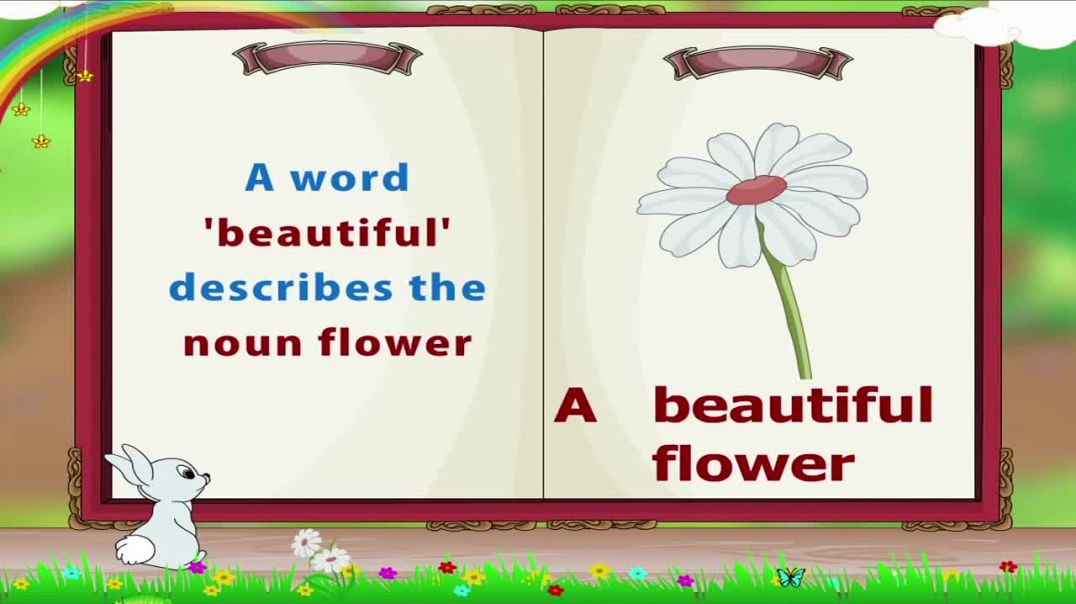
An adjective is a word that modifies or describes a noun or pronoun. Adjectives can be used to describe the qualities of someone or something independently or in comparison to something else. Examples: Adjectives in a sentence I like old houses. The boy is tall and skinny. Jane is smarter than her brother.

#Comma #InvertedComma #ApostropheThis video is part of a playlist having the following videos. Watch all of them in sequence for a better learning experience.Enjoy learning :)Video No.1: Punctuation(Part-1) - Capitalization and use of Periodhttps://youtu.be/5OIWd7A0Z6oVideo No.2: Punctuation(Part-2) |Period, Question Mark, Exclamation Markhttps://youtu.be/RnUuRAHZ9JAVideo No.3: Using Apostrophehttps://youtu.be/OfNMsrz9A-wVideo No.4: Usage Of Question Mark-Part-1https://youtu.be/oiVrAnZhK5IVideo No.5: Usage Of Question Mark- Part-2https://youtu.be/yakNPXHO2l8Video No.6: Rules for Using Commas (Part- 3)https://youtu.be/gnaikjslshoVideo No.7: Usage of Comma, Inverted Comma, and Apostrophehttps://youtu.be/LHHdMj-XUy8Video No.8: Usage Of Hyphenhttps://youtu.be/sr2dglU4fegVideo No.9: Usage Of Colonhttps://youtu.be/EiUciRaXZ1IVideo No.10: Usage Of Semi-Colonhttps://youtu.be/BLRTH4RpOyo Video No.11: Three Types of Dash-Hyphen(-), En-dash (–), Em-dash(—)https://youtu.be/Yjr7wYr8IHQTopics Covered:This video teaches how to use a comma, inverted comma, and apostrophe.I hope you liked our video.Kids should spend time watching informative videos and expand their knowledge day by day.Kids retain what they see in audio-visual lessons so make them watch informative videos rather than cramming things.If you want to learn any topic, please free to write to us, we will upload the video to help you out as soon as possible.We can also create a customized u tube playlist for the topics you want to learn.Your feedback is important to us.Stay connected with us:tutwayhelpdesk@gmail.comYouTube: https://www.youtube.com/channe....l/UCL-KeqwBmYvEBpAiU https://www.facebook.com/tutwa....y/https://www.tutway us:Welcome to Tutway.A unique platform where learning is fun.Now there is no distinction between kids’ fun time and study time.At Tutway, we believe in a very simple idea that audio-visual learning is the most effective tool for grasping knowledge. Many researchers have proven that kids learn a lot by playing interactive games and watching audio-visual animated lessons as compared to reading from books.That's when Tutway comes to the rescue.Tutway is a supplementary education program where kids can learn at their own pace. The students can watch animated videos that are so meticulously made that they can understand even the most complex concepts very easily. There is a question bank at the end of each video where students can answer those questions multiple times and test whether they have grasped knowledge completely or not.We have information systems embedded in the program where parents can monitor real-time performance of their kids and get up to date information about their performance, including quizzes attempted and the marks got in each quiz, both in tabular and graphical formats. Regular reports are e-mailed to the parents so that the parents can analyze their kids’ performance.If we want to learn high-level concepts, we should have a clear understanding of the basic concepts. For instance, if kids don't know about addition and subtraction, they cannot do multiplication, and if they don't know about multiplication, they cannot do division, and if they don't have knowledge of these four basic operations, Algebra cannot be done by them, and it goes on and on.The same applies to the English language if kids don't have sound knowledge of grammar and vocabulary; it becomes extremely difficult for them to have their communication skills.Knowledge of the scientific concepts is also required for observing physical, chemical, biological phenomena happening all around us.That is why; Tutway has thousands of animated videos on Maths, English, and Science to clear the basics of these subjects. It perfectly suits most of the educational needs of most of the students, regardless of their learning abilities.So hurry up, download the Tutway app and book a free demo cl**** to make education interactive and fun experience.

So, what are vocabulary building skills? Vocabulary building skills are what children need to develop their growing vocabulary. Teachers typically encourage children to read widely and research. That's what building a vocabulary is - seeing a new word, researching what it means, and tucking it away to use later.

Grade 8 Mathematics

Grade 8 Social Studies

Grade 10 English
a punctuation mark (,) indicating a pause between parts of a sentence or separating items in a list.

020 - Ionic Bonding
In this video Paul Andersen explains how ionic solids form when cations and anions are attracted. When atoms lose or gain electrons they form ions. The strength of the attraction between ions is based on the amount of charge and the distance between the ions.
Music Attribution
Title: String Theory
Artist: Herman Jolly
http://sunsetvalley.bandcamp.c....om/track/string-theo
All of the images are licensed under creative commons and public domain licensing:
"File:Cat November 2010-1a.jpg." Wikipedia, the Free Encyclopedia, July 19, 2013. http://en.wikipedia.org/w/index.php?title=File:Cat_November_2010-1a.jpg&oldid=517556234.
"File:Chloride-ion-3D-vdW.png." Wikipedia, the Free Encyclopedia. Accessed August 12, 2013. http://en.wikipedia.org/wiki/F....ile:Chloride-ion-3D-
"File:CoulombsLaw.svg." Wikipedia, the Free Encyclopedia. Accessed August 12, 2013. http://en.wikipedia.org/wiki/File:CoulombsLaw.svg.
"File:NaCl Polyhedra.png." Wikipedia, the Free Encyclopedia. Accessed August 12, 2013. http://en.wikipedia.org/wiki/F....ile:NaCl_polyhedra.p
"File:NaCl.png." Wikipedia, the Free Encyclopedia. Accessed August 12, 2013. http://en.wikipedia.org/wiki/File:NaCl.png.
"File:Periodic Trends.svg." Wikipedia, the Free Encyclopedia. Accessed August 12, 2013. http://en.wikipedia.org/wiki/F....ile:Periodic_trends.
"File:Sodium-bromide-3D-ionic.png." Wikipedia, the Free Encyclopedia. Accessed August 12, 2013. http://en.wikipedia.org/wiki/F....ile:Sodium-bromide-3
"File:Sodium-fluoride-3D-ionic.png." Wikipedia, the Free Encyclopedia. Accessed August 12, 2013. http://en.wikipedia.org/wiki/F....ile:Sodium-fluoride-
"File:Sodium-iodide-3D-ionic.png." Wikipedia, the Free Encyclopedia. Accessed August 12, 2013. http://en.wikipedia.org/wiki/F....ile:Sodium-iodide-3D

Mr. Andersen explains the basics of balancing chemical equations. A visual guide shows you how to change coefficients to balance the atoms in reactants and products.
Intro Music Atribution
Title: I4dsong_loop_main.wav
Artist: CosmicD
Link to sound: http://www.freesound.org/peopl....e/CosmicD/sounds/725
Creative Commons Atribution License

Grade 10 English

Grade 10 English

Grade 10 English

🔥 Ace your biology cl****! Start your free trial to the world’s best AP Biology curriculum at https://learn-biology.com
➡️ Studying for a test? Download Mr. W's Ultimate Biology checklist and crush it on you next biology test! https://apbiosuccess.com/checklist
🎵 Do you want to sing along? Download Mr. W's Sciencemusicvideos Songbook https://apbiosuccess.com/songbook
SUMMARY: This karaoke-style music video provides a musical explanation of the structure of the cell membrane. This includes the structure of phospholipids, the key structural component of biological membranes, and how phospholipids interact with water to organize themselves into a phospholipid bilayer. The roles of membranes proteins, carbohydrates, and cholesterol is also discussed.
====================
📝Read below to see how you can benefit by using learn-biology.com📝
====================
⭐️ TEACHERS: Start with a free-trial account that gives your students access to interactive tutorials and allows you to monitor student work: https://learn-biology.com/ap-bio-teacher/
⭐️ PARENTS: A guaranteed 4 or 5 for your son or daughter on the AP Bio Exam: https://learn-biology.com/parents/
⭐️ PROFESSORS: Help your students master the most complex topics in biology. Sign for a free trial at: https://learn-biology.com/college-biology-success/
====================
📝Learn more about Biomania, the app that puts AP Bio success in your pocket.📝
====================
🔥 BIOMANIA: THE BEST AP BIO PREPARATION APP: https://learn-biology.com/app/
Lyrics:
If you're in a cell's cytoplasm, heading outside,
Your last stop's a barrier, 8 nanometers wide,
The cell membrane: our subject for today
It's as basic to life as DNA
It's Selectively permeable, like a border patrol
of a country it maintains control.
Selecting what leaves or what gains entry
It's a guard, bouncer, watchman, patrolman or sentry.
But not just a guard, it sends signals in nerves
White blood cells use their membranes to eat germs like hors d'oeuvres,
Membranes have receptors, enzymes and junctions,
So what kinds of structure can have all these functions?
CHORUS
C-E double L, "Mem" B-R-A-N-E
Controlling transport selective permeability
Phospholipids, Carbohydrates, Proteins and Cholesterol
The Fluid Mosaic Bilayer in us all
So let's take a look at what makes up the membrane,
Phospholipids rule this domain,
In fact membrane structure emerges directly
from phospholipids' chemical properties.
There's a head and a tail on every phospholipid,
The tail's two long chain fatty acids
Bound to a glycerol, it's made to order
The tail's non-polar --hydrophobic-- fears water
The head's got a phosphate, it's charged negatively,
makes the head hydrophilic--plays in water happily
So tail avoids water while the head's attracted to it,
When phospholipids form the membrane that's how they do it.
Cause when phospholipids into water get submerged,
A phospholipid bilayer structure will emerge
The tails hang together in a water free zone,
Hear their hydrophobic moan, "water leave me alone!"
While the heads are sticking out touching all those H2Os
Tails in, heads out, it's how every membrane goes
Tails in, heads out, in a cellular sphere,
It's the bilayered basis of membranes everywhere.
CHORUS
But a cell membrane's not just a phospholipid scene
There's cholesterol, carbohydrates, lots of proteins.
In fact, membrane proteins have a presence so great,
that they often exceed the phospholipids by weight.
And all of these components are in constant motion,
Moving, mixing like a boiling potion,
Flowing like dancers in a party in Pasaic
That's why the membrane's thought of as a fluid mosaic.
Let's start with proteins since they're key in this mix.
Transmembrane proteins span the entire width.
Typically they're ports--think of channels or conveyors,
For things that don't go through the lipid bilayer.
Any protein embedded in the hydrophobic middle
Built right into the inside is considered integral
While peripheral proteins either hang on the exterior,
Or inside on the cytoplasmic interior.
Cholesterol keeps membranes flowing with ease,
In cold it keeps the lipids moving so they don't freeze,
In heat it slows the lipids down limiting their traveling,
Cholesterol: it keeps membranes from unraveling
Membrane carbohydrates work as markers or signs
So your immune system knows which flag your cells are flyin'
The blood types AB, O, and B and A
Are about the carbohydrates on red blood cell membranes.
CHORUS