Top videos

Sacrifice, risen, God, Easter, April, bonnet, Easter basket, Easter egg, chocolate bunny, basket, parade, rabbit, hunt, celebration, chick, Jesus, miracle, prayer, Palm Sunday, Good Friday, Easter Service, crucifixion, crucify, resurrection, cross, holy, Lent, bouquet, bunny, chocolate, Easter egg hunt, Happy Easter!

Grade 10 Commerce
GCSE Biology module (sample): DNA and genes <br /><br />By the end of this topic you will have covered: <br />- DNA, genes and genetic code <br />- Genetic modification <br /><br />Get the grades you need in GCSE Biology - access HD-quality GCSE revision videos and apps from LearnersCloud: <br />http://www.learnerscloud.com/s....tudent/products/gcse <br /><br />To find out more and to start a free trial visit: <br />http://www.learnerscloud.com/s....tudent/home/gcse/gcs

Grade 10 Commerce
A real cl****room Biology lesson on the topic of Photosynthesis. British Private Schooling in a Real TV Studio. Part of the SmartLearn Private School at Home series.

a comparison of two otherwise unlike things based on resemblance of a particular aspect. : resemblance in some particulars between things otherwise unlike : similarity. : inference that if two or more things agree with one another in some respects they will probably agree in others.

Grade 10 Commerce

Grade 8 Social Studies

Britannica Dictionary definition of THEME. [count] 1. : the main subject that is being discussed or described in a piece of writing, a movie, etc. The quest for power is the underlying theme of the film.
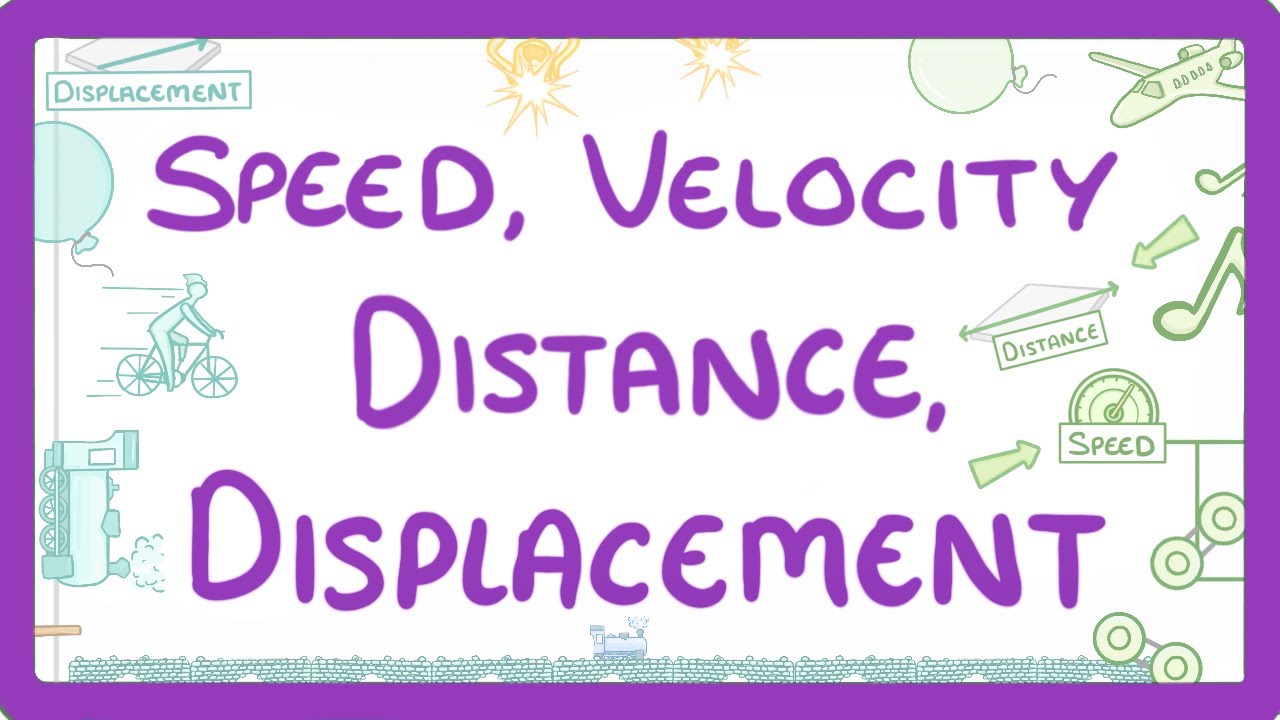
This video covers:
- The difference between scalar and vector quantities
- Why speed is scalar, but velocity is a vector
- The difference between distance and displacement
- How to calculate speed and velocity
- Common speeds you need to remember
General info:
- Suitable for all GCSE and IGCSE courses
- Suitable for higher and foundation tiers
- Suitable for triple and combined science
Exam board specific info:
AQA - Everything is relevant to your course!
IGCSE Edexcel - Everything is relevant to your course!
Edexcel - Everything is relevant to your course!
OCR 21st Century - Everything is relevant to your course!
OCR Gateway - Everything is relevant to your course!
GCSE Chemistry playlist:
https://www.youtube.com/watch?v=fN8kH9Vvqo0&list=PLidqqIGKox7WeOKVGHxcd69kKqtwrKl8W
GCSE Biology Playlist:
https://www.youtube.com/watch?v=--dIBinUdeU&list=PLidqqIGKox7X5UFT-expKIuR-i-BN3Q1g
GCSE Physics Playlist:
https://www.youtube.com/watch?v=aHVJfRxeAxo&list=PLidqqIGKox7UVC-8WC9djoeBzwxPeXph7

Context clues are hints found within a sentence, paragraph, or p****age that a reader can use to understand the meanings of new or unfamiliar words.
Irregular verbs are verbs that do not follow the normal patterns for tense and past participle. While most English regular verbs use the ending “-ed” for the past tense and participle forms, irregular verbs each have their own unique tense forms and past participles.

#TypesofAdverbs
This video is part of a playlist having the following videos. Watch all of them in sequence for a better learning experience.
Enjoy learning :)
Video no.1 Position Of Adverbs
https://youtu.be/ZNbyrQ3pxVk
Video no.2 Adverbs For Comparison
https://youtu.be/9k3g7Sx6LH0
Video no.3 Adverbial Phrase
https://youtu.be/vnVtWhTRXUo
Video no.4 Introduction To Adverbs
https://youtu.be/ZWbujqoRajk
Video no.5 Learning Types Of Adverbs
https://youtu.be/iSuvV3nsKgc
Topics Covered:
Adverbs
Types of adverbs
Adverbs basics are taught in the video - Basics of Adverbs- link given below:-
https://youtu.be/ZWbujqoRajk
I hope you liked our video.
Kids should spend time watching informative videos and expand their knowledge day by day.
Kids retain what they see in audio-visual lessons so make them watch informative videos rather than cramming things.
If you want to learn any topic, please free to write to us, we will upload the video to help you out as soon as possible.
We can also create a customized u tube playlist for the topics you want to learn.
Your feedback is important to us.
Stay connected with us:
tutwayhelpdesk@gmail.com
YouTube: https://www.youtube.com/channe....l/UCL-KeqwBmYvEBpAiU
Facebook: https://www.facebook.com/tutway/
https://www.tutway.com/
About us:
Welcome to Tutway.
A unique platform where learning is fun.
Now there is no distinction between kids’ fun time and study time.
At Tutway, we believe in a very simple idea that audio-visual learning is the most effective tool for grasping knowledge. Many researchers have proven that kids learn a lot by playing interactive games and watching audio-visual animated lessons as compared to reading from books.
That's when Tutway comes to the rescue.
Tutway is a supplementary education program where kids can learn at their own pace. The students can watch animated videos that are so meticulously made that they can understand even the most complex concepts very easily. There is a question bank at the end of each video where students can answer those questions multiple times and test whether they have grasped knowledge completely or not.
We have information systems embedded in the program where parents can monitor real-time performance of their kids and get up to date information about their performance, including quizzes attempted and the marks got in each quiz, both in tabular and graphical formats. Regular reports are e-mailed to the parents so that the parents can analyze their kids’ performance.
If we want to learn high-level concepts, we should have a clear understanding of the basic concepts. For instance, if kids don't know about addition and subtraction, they cannot do multiplication, and if they don't know about multiplication, they cannot do division, and if they don't have knowledge of these four basic operations, Algebra cannot be done by them, and it goes on and on.
The same applies to the English language if kids don't have sound knowledge of grammar and vocabulary; it becomes extremely difficult for them to have their communication skills.
Knowledge of the scientific concepts is also required for observing physical, chemical, biological phenomena happening all around us.
That is why; Tutway has thousands of animated videos on Maths, English, and Science to clear the basics of these subjects. It perfectly suits most of the educational needs of most of the students, regardless of their learning abilities.
So hurry up, download the Tutway app and book a free-demo cl**** to make education interactive and fun experience.
A verb is a word that indicates a physical action (e.g., “drive”), a mental action (e.g., “think”), or a state of being (e.g., “exist”). Every sentence contains a verb. Verbs are almost always used along with a noun or pronoun to describe what the noun or pronoun is doing.
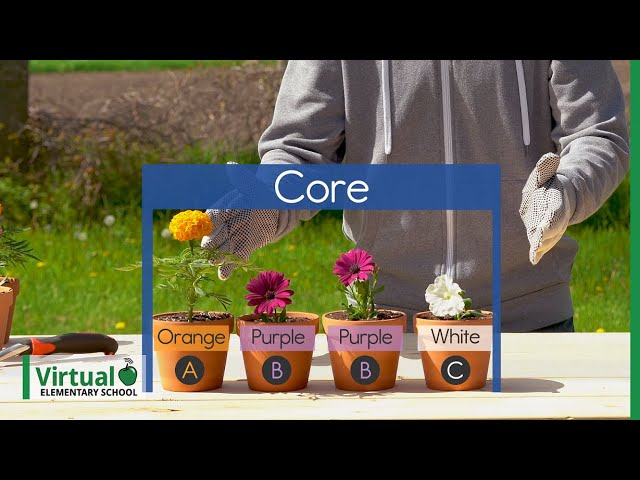
Learn how to create a pattern in this video from our Grade 1 Math course.
View our full list of course offerings:
https://www.virtualelementarys....chool.com/register.p
Copyright © 2021 by D2L Corporation. All rights reserved. Except where otherwise noted, all content is created and owned by D2L Corporation.
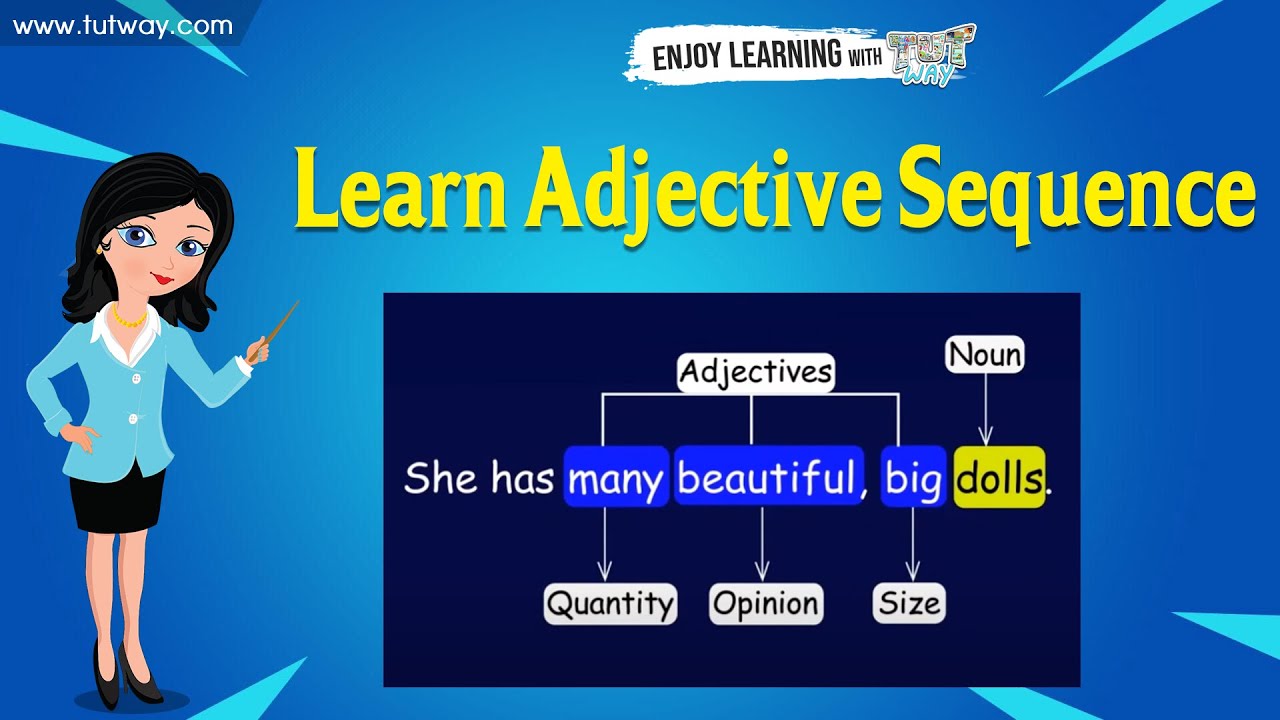
#AdjectiveSequence
This video is part of a playlist having the following videos. Watch all of them in sequence for a better learning experience.
Enjoy learning :)
Video No.1: Describing words
https://youtu.be/MofJXWoGOdY
Video No.2: Adjectives For Comparison
https://youtu.be/n5oAL9h7rGQ
Video No.3: Kinds Of Adjectives - Part 1
https://youtu.be/Y3NqN6cHQIA
Video No.4: Possessive Adjectives and Proper Adjectives
https://youtu.be/13HRKXXE_Ew
Video No.5: Adjective Phrase
https://youtu.be/S1jAzcApTpE
Video No.6: Learn Adjective Sequence
https://youtu.be/3_W6JT_SFts
Video No.7: Coordinate Adjectives
https://youtu.be/-gC6Fn-RDa8
Topics Covered:
Adjectives
Adjective Sequence
I hope you liked our video.
Kids should spend time watching informative videos and expand their knowledge day by day.
Kids retain what they see in audio-visual lessons so make them watch informative videos rather than cramming things.
If you want to learn any topic, please free to write to us, we will upload the video to help you out as soon as possible.
We can also create a customized u tube playlist for the topics you want to learn.
Your feedback is important to us.
Stay connected with us:
tutwayhelpdesk@gmail.com
YouTube: https://www.youtube.com/channe....l/UCL-KeqwBmYvEBpAiU
Facebook: https://www.facebook.com/tutway/
https://www.tutway.com/
About us:
Welcome to Tutway.
A unique platform where learning is fun.
Now there is no distinction between kids’ fun time and study time.
At Tutway, we believe in a very simple idea that audio-visual learning is the most effective tool for grasping knowledge. Many researchers have proven that kids learn a lot by playing interactive games and watching audio-visual animated lessons as compared to reading from books.
That's when Tutway comes to the rescue.
Tutway is a supplementary education program where kids can learn at their own pace. The students can watch animated videos that are so meticulously made that they can understand even the most complex concepts very easily. There is a question bank at the end of each video where students can answer those questions multiple times and test whether they have grasped knowledge completely or not.
We have information systems embedded in the program where parents can monitor real-time performance of their kids and get up to date information about their performance, including quizzes attempted and the marks got in each quiz, both in tabular and graphical formats. Regular reports are e-mailed to the parents so that the parents can analyze their kids’ performance.
If we want to learn high-level concepts, we should have a clear understanding of the basic concepts. For instance, if kids don't know about addition and subtraction, they cannot do multiplication, and if they don't know about multiplication, they cannot do division, and if they don't have knowledge of these four basic operations, Algebra cannot be done by them, and it goes on and on.
The same applies to the English language if kids don't have sound knowledge of grammar and vocabulary; it becomes extremely difficult for them to have their communication skills.
Knowledge of the scientific concepts is also required for observing physical, chemical, biological phenomena happening all around us.
That is why; Tutway has thousands of animated videos on Maths, English, and Science to clear the basics of these subjects. It perfectly suits most of the educational needs of most of the students, regardless of their learning abilities.
So hurry up, download the Tutway app and book a free-demo cl**** to make education interactive and fun experience.
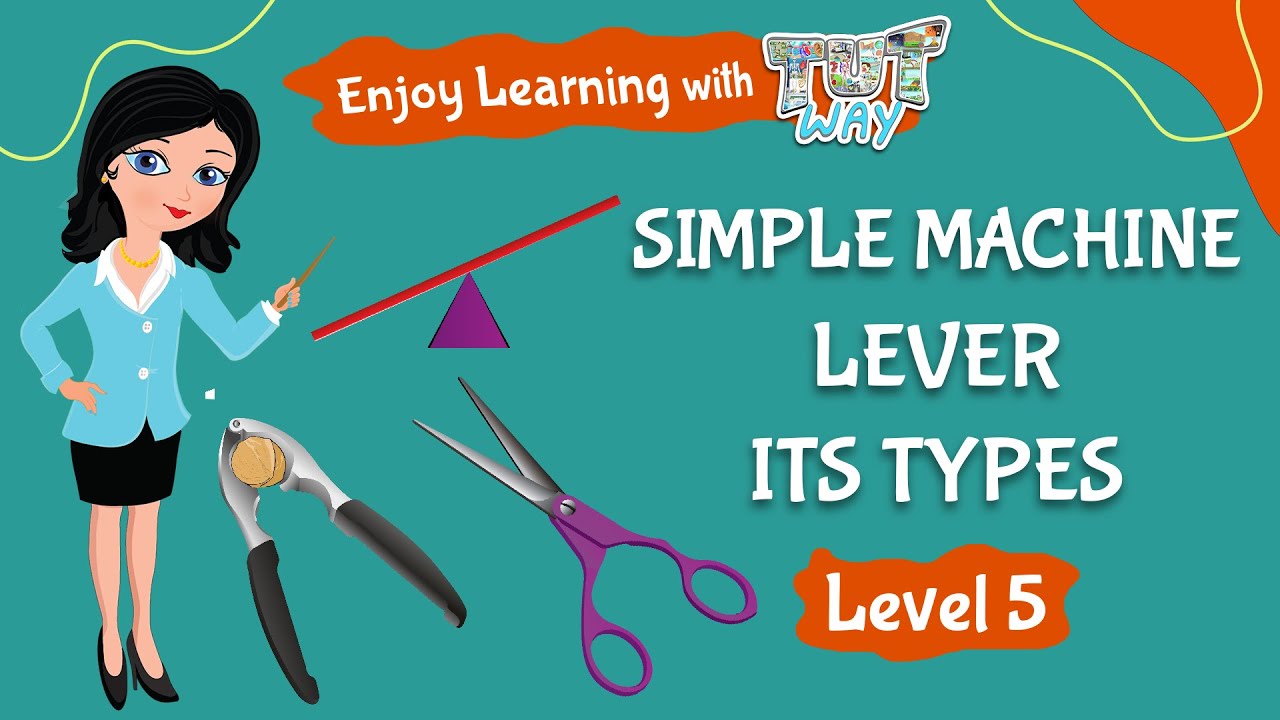
Topics covered:
• Parts of a lever: Fulcrum, Load, and Effort
• Types of lever
• First-cl**** lever
• Second cl**** lever
• Third cl**** lever
• Examples a first-cl**** lever
• Examples of a second-cl**** lever
• Examples of a third-cl**** lever
Welcome to Tutway, a unique platform where learning is fun !
Now there is no distinction between kids' fun time and study time. Say goodbye to the days of cramming those dull and ponderous books, which made learning a tedious task. We believe in the straightforward idea that audio-visual learning is the most effective tool for learning. Many researchers have proven that kids learn a lot by playing interactive games and watching audio-visual animated lessons compared to reading from books. To understand the new concepts, Kids show more interest in adopting unique ways of learning. We have brought a programme that covers the crucial ideas and makes learning more stable that stimulates the critical thinking of the young learners !
Let's break away from our perception that adopting new learning concepts is challenging. You will find our website & youtube channel very user-friendly and interactive to gain knowledge. Even kids can access the content without constant parental supervision !
Site: https://www.tutway.com/
Email: tutwayhelpdesk@gmail.com
Facebook: https://www.facebook.com/tutway/

Grade 10 Accounts
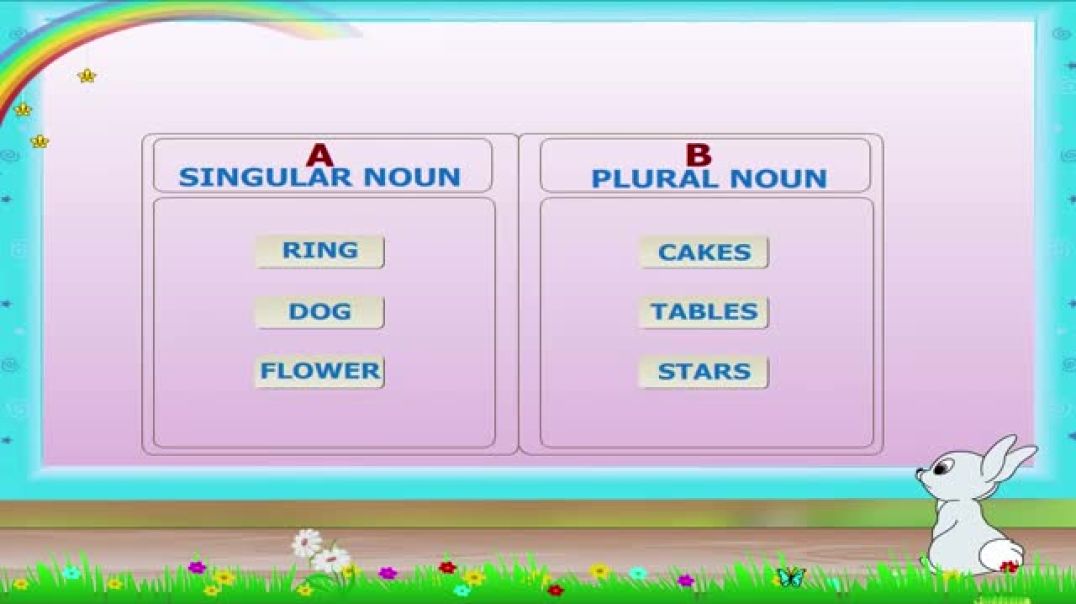
The number denotes whether we speak of one object or more. Singular Number- A Noun that denotes one person or thing is said to be in the singular number; as, man, boy, girl, bird, etc.

#WaterPollution #CausesNSources
This video is part of a playlist having the following videos. Watch all of them in sequence for a better learning experience.
Enjoy learning :)
Video no.1 Sources of Water Pollution
https://youtu.be/BaEp9aoKK1Y
Video no.2 Causes of Water Pollution
https://youtu.be/9i0ahRPWwmI
Video no.3 Water Pollution - Its Effects and Preventions
https://youtu.be/h73DE33BrQ0
Video no.4 Our Atmosphere and its Pollutants
https://youtu.be/1klv5CoZQdk
Video no.5 Air pollution – Its Effects, Causes, and Prevention
https://youtu.be/kPbpTRXB_H0
Video no.6 Biodegradable and Non-Biodegradable Waste
https://youtu.be/aTflLRf7WS4
Video no.7 Conserving our Environment
https://youtu.be/-HE8HnoXbBs
Topic covered:
Water pollution Causes of water pollution:
• Factories
• Sewage
• Household waste
• Highway runoffs
• Pollution from heavy metals and chemicals
• Oil spill
• Farming
• Plastic pollution
Hope you liked our video.
Kids should spend time watching informative videos and expand their knowledge day by day.
Kids retain what they see in audio-visual lessons so make them watch informative videos rather than cramming things.
If you want to learn any topic, please free to write to us, we will upload the video to help you out as soon as possible.
We can also create a customized u tube playlist for the topics you want to learn.
Your feedback is important to us.
Stay connected with us:
tutwayhelpdesk@gmail.com
YouTube: https://www.youtube.com/channe....l/UCL-KeqwBmYvEBpAiU
Facebook: https://www.facebook.com/tutway/
https://www.tutway.com/
About us:
Welcome to Tutway.
A unique platform where learning is fun.
Now there is no distinction between kids’ fun time and study time.
At Tutway, we believe in a very simple idea that audio-visual learning is the most effective tool for grasping knowledge. Many researchers have proven that kids learn a lot by playing interactive games and watching audio-visual animated lessons as compared to reading from books.
That's when Tutway comes to the rescue.
Tutway is a supplementary education program where kids can learn at their own pace. The students can watch animated videos which are so meticulously made that they can understand even the most complex concepts very easily. There is a question bank at the end of each video where students can answer those questions multiple times and test whether they have grasped knowledge completely or not.
We have information systems embedded in the program where parents can monitor real-time performance of their kids and get up to date information about their performance, including quizzes attempted and the marks got in each quiz, both in tabular and graphical formats. Regular reports are e-mailed to the parents so that the parents can analyze their kids’ performance.
If we want to learn high-level concepts, we should have a clear understanding of the basic concepts. For instance, if kids don't know about addition and subtraction, they cannot do multiplication, and if they don't know about multiplication, they cannot do division, and if they don't have knowledge of these four basic operations, Algebra cannot be done by them, and it goes on and on.
Same applies to the English language if kids don't have sound knowledge of grammar and vocabulary; it becomes extremely difficult for them to have their communication skills.
Knowledge of the scientific concepts is also required for observing physical, chemical, biological phenomena happening all around us.
That is why; Tutway has thousands of animated videos on Maths, English, and Science to clear the basics of these subjects. It perfectly suits most of the educational needs of most of the students, regardless of their learning abilities.
So hurry up, download the Tutway app and book a free-demo cl**** to make education interactive and fun experience.